


Why pass-to-pass repeatability, not absolute accuracy, decides whether a field gets overlap
A GPS antenna for precision agriculture is judged by a different metric than a survey antenna. The farmer does not care where the tractor is in a global datum; the farmer cares whether the second pass lands exactly where the first one did. That requirement — pass-to-pass repeatability — is affected by antenna placement, mounting rigidity, terrain compensation, and vibration far more than by the receiver's static accuracy specification.
This guide covers what actually determines guidance quality in the field, where the antenna should sit on different machine types, how roll and terrain affect the position the system reports, and which environmental factors quietly degrade performance over a season.
The Accuracy Metric That Actually Matters in a Field
Two numbers describe guidance performance, and they are frequently confused. Absolute accuracy describes how close the reported position is to the true position on the earth. Pass-to-pass accuracy describes how closely the second pass follows the first. For spraying, seeding, and spreading, the second number is the one that determines overlap, skips, and input waste.
A system with modest absolute accuracy but excellent repeatability produces a clean field. A system with excellent absolute accuracy but variable repeatability produces streaks and overlaps that cost money every season. This is why a farm can be perfectly satisfied with a system whose absolute error is several centimetres, as long as the passes agree with each other.
Repeatability is largely a function of stability: a stable antenna position on the machine, a stable phase centre, and a stable correction link. Anything that moves the antenna relative to the machine, or changes its electrical behaviour between passes, undermines the metric the grower actually experiences.
Antenna Placement and the Lever Arm Problem
The antenna measures the position of the antenna, not the position of the implement. Every guidance system has to translate one into the other, and that translation is where most avoidable error enters a field operation.
- Mount on the cab roof, centred where possible. The cab roof is usually the highest rigid metal surface with a clear sky view. A centred position keeps the pattern symmetrical and uses the roof as a ground plane. Mounting on a plastic roof panel without a metal plane underneath is one of the most common causes of poor satellite tracking on farm machinery.
- Measure the offset once, precisely. The distance from the antenna to the machine reference point, and from that point to the implement, must be entered accurately. A small offset error in the fore-aft direction shows up as a consistent pass shift that the operator will try to correct by steering, which compounds the problem.
- Avoid the exhaust and the beacon. Heat and nearby radiating structures both affect antenna behaviour. A beacon mast directly beside the antenna can distort the pattern in a way that is invisible until the machine works next to a treeline.
- Keep the cable short and well routed. Long cable runs add loss and pick up interference from the alternator and hydraulic control circuits. If a longer run is unavoidable, use a low-loss assembly rather than a thin general-purpose coax.
Roll, Pitch, and Terrain Compensation
An antenna mounted a few metres above the ground moves laterally by a significant distance when the machine rolls. On a side slope, a 3-metre-high antenna on a machine rolling five degrees shifts roughly 26 centimetres horizontally. That is larger than the guidance tolerance of most operations, and it is the reason terrain compensation exists.
There are two ways to handle it. The first is an inertial sensor that measures roll and pitch and the software corrects the reported position to the ground reference point. The second is a dual-antenna configuration that measures the machine's attitude directly from the phase difference between two antennas. Both work; the inertial approach depends on calibration quality and drifts over time, while the dual-antenna approach is self-contained but requires a rigid baseline across the roof.
Whichever method the system uses, the antenna mounting has to be rigid. A roof mount that flexes with the suspension introduces a roll error the compensation cannot see, because the sensor and the antenna are not moving together.
Environmental Conditions That Degrade Performance Over a Season
Farm machinery operates in an environment that is unusually hostile to a radome. Dust from tillage, chemical spray drift, fertiliser granules, and high-pressure washdown all attack the housing, and the damage accumulates slowly enough that the operator rarely connects it to a gradual loss of guidance quality.
| Condition | Effect on the antenna | Design response |
|---|---|---|
| Dust and soil film | Detuning when wet, higher noise floor | Smooth non-porous radome, sealed housing |
| Chemical spray drift | Surface degradation, connector corrosion | UV-stable housing, sealed connector interface |
| Vibration | Connector wear, phase noise under motion | Rigid mount, strain relief, locking connector |
| Thermal cycling | Phase centre drift during the day | Mechanically stable element, cast housing |
| Washdown | Water ingress at the connector | IP67 sealing and a defined mating procedure |
A practical maintenance rule is to inspect and clean the radome at the same interval as the air filter. The two components fail in the same way — gradually, invisibly, and with a cost that shows up later as extra overlap or a missed strip.
Matching the Antenna to the Machine
Different implements change what the guidance system has to do, and the antenna selection should follow.
- Tractors on tillage. Wide implements and rolling terrain make terrain compensation essential. A single antenna with a properly calibrated inertial unit is usually sufficient, provided the mount is rigid.
- Sprayers. Section control depends on accurate implement position, so the lever arm calculation has to include the boom width. Pass-to-pass repeatability directly determines chemical savings.
- Combines. The header position matters more than the machine position. Vibration levels are high, so connector security and mount rigidity deserve extra attention.
- Autonomous and high-speed machines. A dual-antenna configuration gives heading directly and reduces dependence on inertial calibration, which becomes valuable when the machine operates without an operator to notice drift.
Yonghao Innovation GPS and RTK Antenna Range for Agriculture
Yonghao Innovation Tech is a national high-tech enterprise established in 2014, based in Shenzhen, Guangdong, China. We integrate research, manufacturing, and sales, and we supply GNSS satellite antennas, positioning terminals, data communication products, and customized high-precision BeiDou solutions for surveying and monitoring, aerospace, communication time service, autonomous driving, machine control, and intelligent transportation.
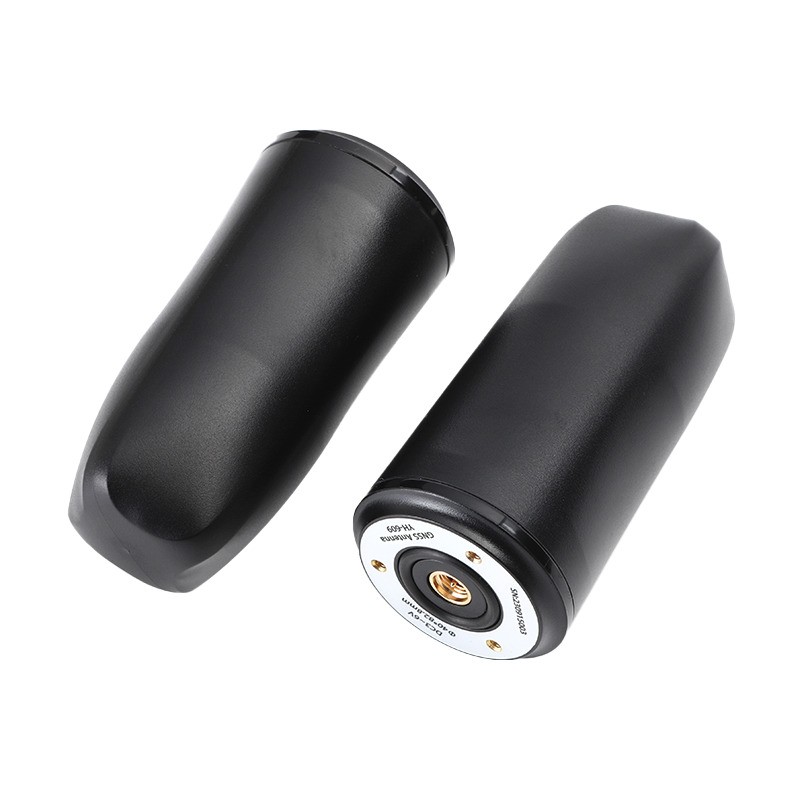
Our GPS antenna range includes the YH-5361, an active BeiDou and GPS antenna that combines a ceramic element with a low-noise amplifier to deliver usable signal to the receiver in weak-signal conditions. For machines that need full-band RTK rather than GPS-only reception, our RTK GNSS antenna family covers survey-grade patches for roof mounting.
Because agricultural installations usually require a specific connector, a longer cable, or a magnetic or bolt-through mount, our product customization team reviews those requirements against the existing platform. The precision agriculture project page shows typical configurations, and the agriculture product collection lists the antenna and receiver combinations we supply for this segment.
Conclusion
Choosing a GPS antenna for precision agriculture is mostly a question of mounting discipline and stability. The antenna has to sit on a rigid metal surface with a clear sky view, its offset has to be measured accurately, and its housing has to survive dust, chemicals, and washdown for years without changing behaviour. Get those three right and the guidance system will deliver the pass-to-pass consistency that saves inputs; get them wrong and no receiver specification will compensate.
Send us your machine type, roof layout, and implement width, and we will recommend an antenna and mounting arrangement.
Plan your agricultural install Read agriculture articlesFrequently Asked Questions
Q1: How accurate should a GPS antenna for precision agriculture be?
Absolute accuracy matters less than pass-to-pass repeatability. Most field operations tolerate a few centimetres of absolute error provided successive passes agree closely, because overlap and skips are caused by disagreement between passes rather than by global offset.
Q2: Where should a GPS antenna for precision agriculture be mounted?
On the cab roof, as close to the centre as the structure allows, on a metal surface large enough to act as a ground plane. Keep it away from the exhaust, beacons, and radio masts, and route the cable clear of high-current harnesses.
Q3: Does a GPS antenna for precision agriculture need a base station?
Centimetre-level guidance requires RTK corrections, which can come from a local base station or a network service. On large properties with reliable mobile coverage, a network service avoids maintaining a base; where coverage is poor, a local base station is usually more dependable.
Q4: Why does a GPS antenna for precision agriculture lose accuracy on slopes?
Because the antenna is mounted several metres above the ground, machine roll moves it laterally. Terrain compensation corrects this using an inertial sensor or a dual-antenna attitude measurement, but it only works if the antenna mount is rigid relative to the sensor.
Q5: How often should a GPS antenna for precision agriculture be serviced?
Inspect the radome and connector at the same interval as the machine's air filter. Clean off chemical residue and dust, check connector torque, and confirm the mount has not loosened. Most gradual guidance degradation on farm machinery traces back to one of those three items.